Science is powerful—but only when shared.
In this section, you’ll find my media contributions, where I bring research beyond academia to spark public dialogue on climate and society.
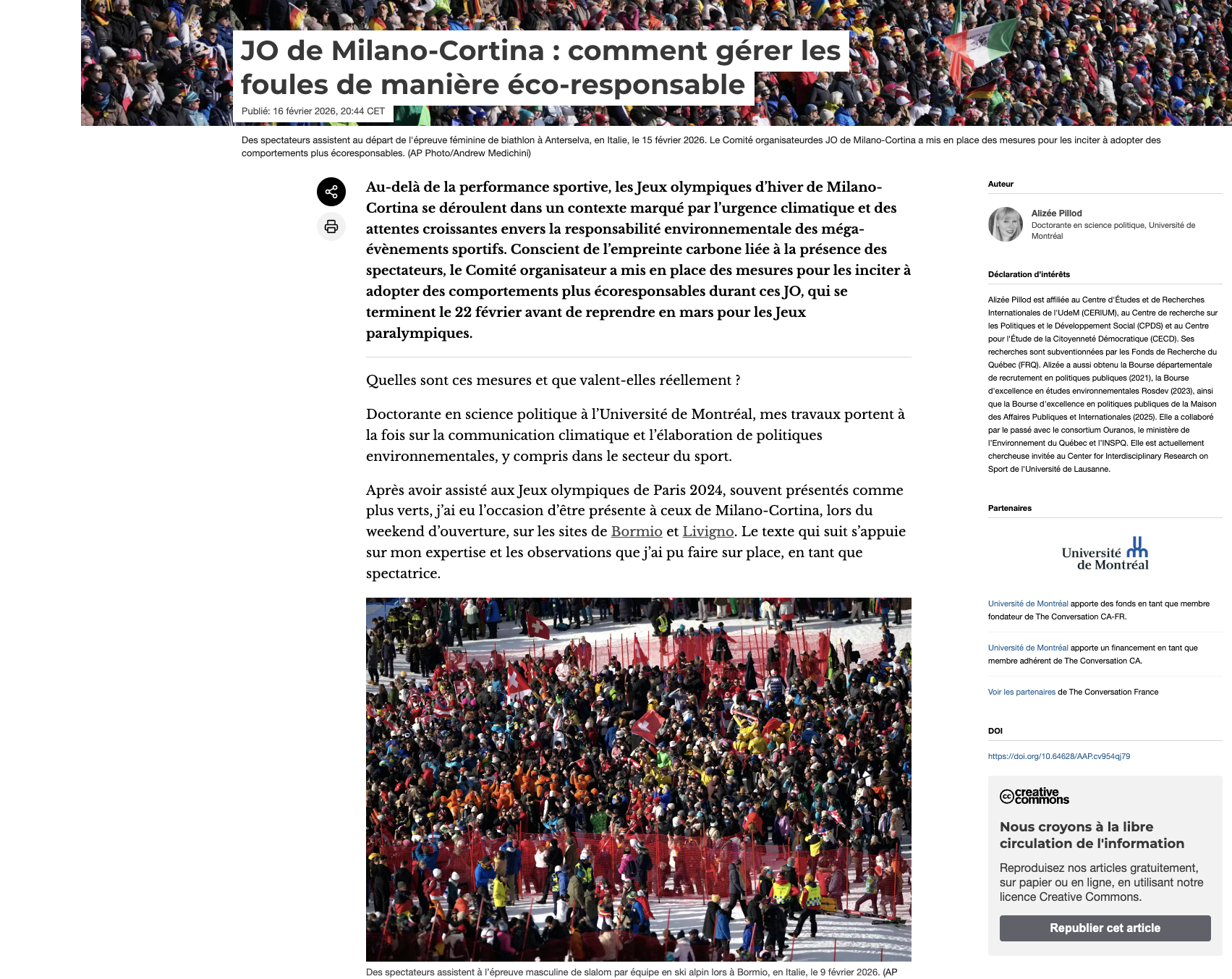
About the carbon footprint of sport spectators
In this article, I examine the carbon footprint of spectators at the Milano-Cortina 2026 Winter Olympics, focusing on transport and waste. Because spectator travel is a major source of emissions, organizers promote rail, shuttle systems, and limits on private car access. They also introduced waste-management measures to encourage sorting and recycling at venues. These initiatives represent important steps, but they remain insufficient.
Read the article (French version)
Read the article (English version)

Radio talks on the future of the Winter Olympics
The Winter Olympic Games are facing an unprecedented climate challenge — and incremental sustainability measures are no longer enough. In this radio segment, James Guilbaud (Sport+Eco) and I discuss the future of the Winter Games, exploring how their carbon and environmental footprints can be reduced and how adaptation strategies, such as artificial snowmaking, are being used to keep competitions possible. But these technical solutions raise deeper questions: how can the Games continue in a context of chronic snow scarcity, and at what cost? As winters become increasingly unreliable, we examine the options available to preserve the Olympic project — and whether its traditional model can survive in a warming world.
- “Feu Vert” – Radio Canada

Radio talks on the sustainability strategy at the Olympics
The Olympic Games are colliding head-on with the climate crisis — and sustainability efforts alone won’t be enough. In these radio segments, I explain how the Olympics have shifted from carbon-mitigation strategies to adaptation measures like artificial snowmaking just to remain possible. But these fixes raise deeper questions: climate change is pushing us to rethink the very spirit of the Games and what their future can be. Nowhere is this more urgent than for the Winter Olympics, whose long-term viability increasingly challenges the foundations of the Olympic project itself.
- “All in a Weekend” – CBC Montreal
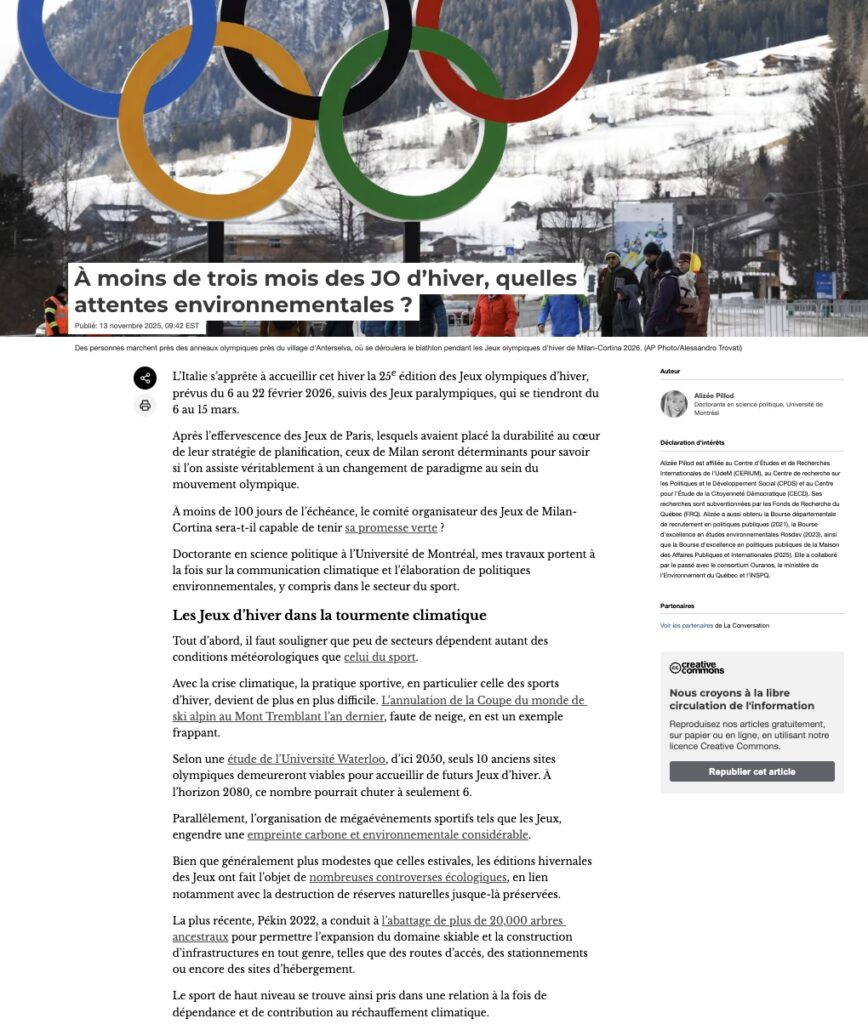
Winter games and sustainability
In this article, I examine the measures implemented by the organizers of the 2026 Milano-Cortina Winter Games to reduce the event’s environmental and carbon footprints. While the strategy is undeniably ambitious and innovative, it is not without shortcomings. With the countdown underway, the real test will be whether these commitments can translate into meaningful and measurable results.
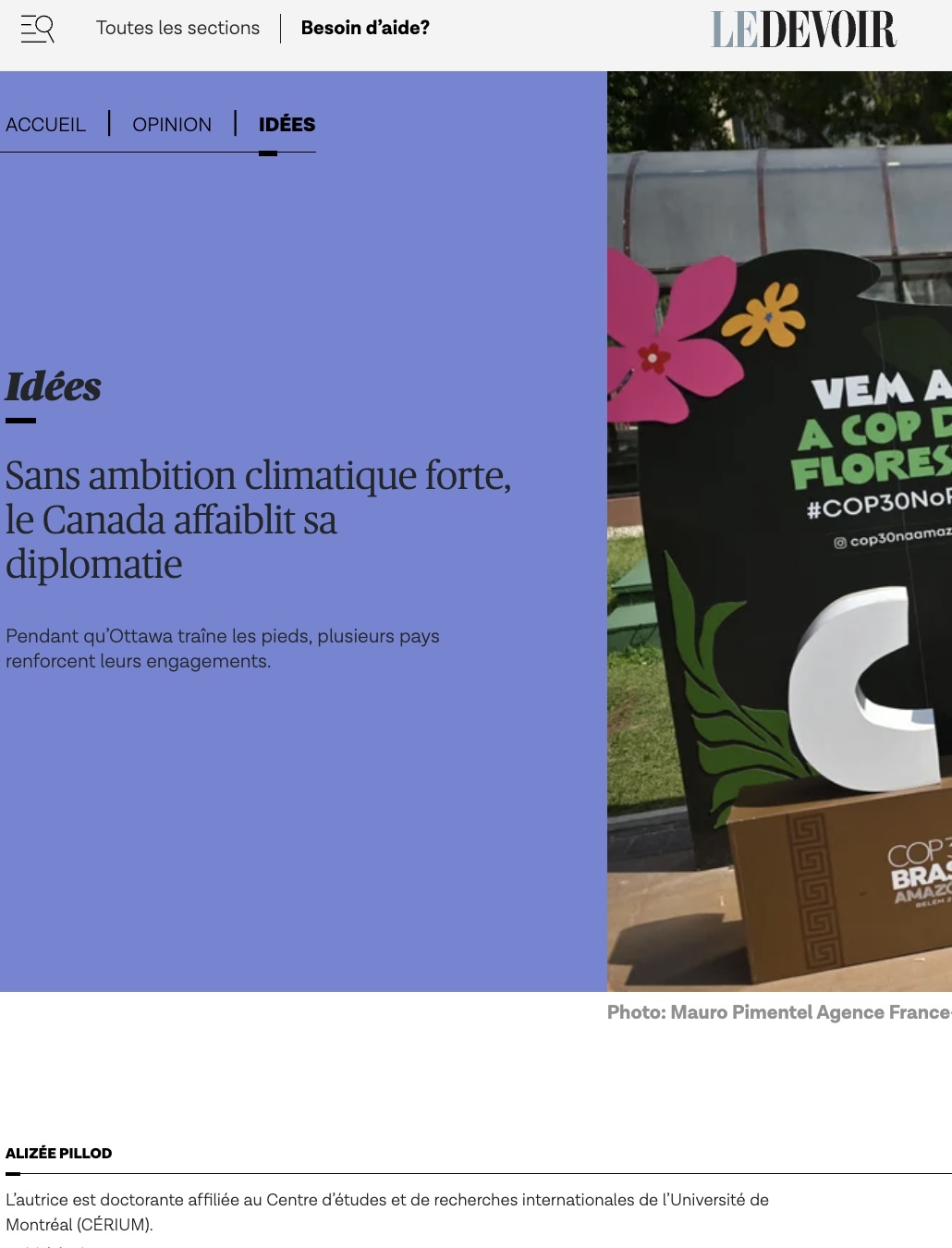
Op-ed on Canada’s climate ambition
In this article, I argue that Canada’s weakened climate ambition under the Carney government undermines its credibility abroad. By rolling back key environmental measures, Canada risks missing its Paris goals and losing influence at COP30. Without stronger action at home, its diplomacy and trade prospects will suffer in a world moving ahead on climate.
Radio talks on wildfire management
Canada’s wildfires are getting bigger, faster, and harder to control — and our current system can’t keep up. In these radio segments, I explain why we need a national fire administration. It’s time to move beyond fragmented responses and build a coordinated, long-term strategy — one that treats wildfires not just as local emergencies, but as a national threat demanding national leadership.
- “Panorama” – Radio Canada Vancouver
- “L’Actuel” – Radio Canada Winnipeg
- “L’Heure de Pointe” – Radio Canada Moncton
- “Sur le Vif” – Radio Canada Ottawa-Gatineau
- “La Croisée” – Radio Canada Edmonton

Time to Fight Fire Together
In this article, I highlight the urgent need for Canada to create a national structure to better manage wildfires. As extreme fires become more frequent and devastating, the current fragmented, provincial approach is no longer enough. Effective coordination, standardized training, and adequate resources are essential to protect lives and ecosystems. The era of patchwork responses is over; it’s time to build a unified national wildfire strategy.

Op-ed on climate finance
In this article, I highlight the urgent need for wealthy countries to move beyond empty promises and finally invest in real climate action. As international summits continue to fall short on financial commitments, it is time to pay up. A fair and just transition cannot happen without significant funding — especially for the countries already bearing the brunt of climate change. The era of symbolic gestures is over; the bill is due.

Radio talks on the climate and health nexus
Climate change isn’t just melting glaciers and fueling wildfires — it’s also making us sick. From heatwaves and air pollution to the spread of infectious diseases and food insecurity, our health is on the front lines of the climate crisis. In these radio talks, I explore how the climate emergency is also a public health emergency — and why protecting the planet means protecting ourselves.
- “Y a pas deux matins pareils” – Radio Canada Toronto
- “Le café show” – Radio Canada Edmonton
- “Matins sans frontières” – Radio Canada Windsor

Climate and health on the campaign trail
Ahead of the June 2024 elections, France’s Green Party leaned on the health impacts of climate change to connect with voters on a personal level. By framing the crisis as a public health threat, they aimed to broaden their appeal — but the strategy lacked depth and ambition. This article examines how the health narrative was used.

The health narrative gaining traction
Once absent from climate negotiations, health has now become a rising theme at the COPs. This article traces how discussions on the health impacts of climate change — heat stress, respiratory diseases, mental health — are increasingly making their way into official agendas and side events. But while visibility is growing, real policy integration remains limited, raising the question: is health being truly prioritized, or simply instrumentalized as a new narrative hook?

COP or COP(s)?
In 2022, the climate and biodiversity COPs nearly overlapped, creating confusion, diluted media attention, and logistical strain. This article explores whether holding the two summits together would foster better policy integration — or simply blur distinct political priorities.