Coming soon
We’ve just wrapped up data collection for the Canadian Climate Framing (CCF) Project, the most comprehensive media database on climate change coverage in Canada to date. Exciting publications are in the works — stay tuned for fresh insights on how climate has been framed in Canadian newspapers over the past five decades!
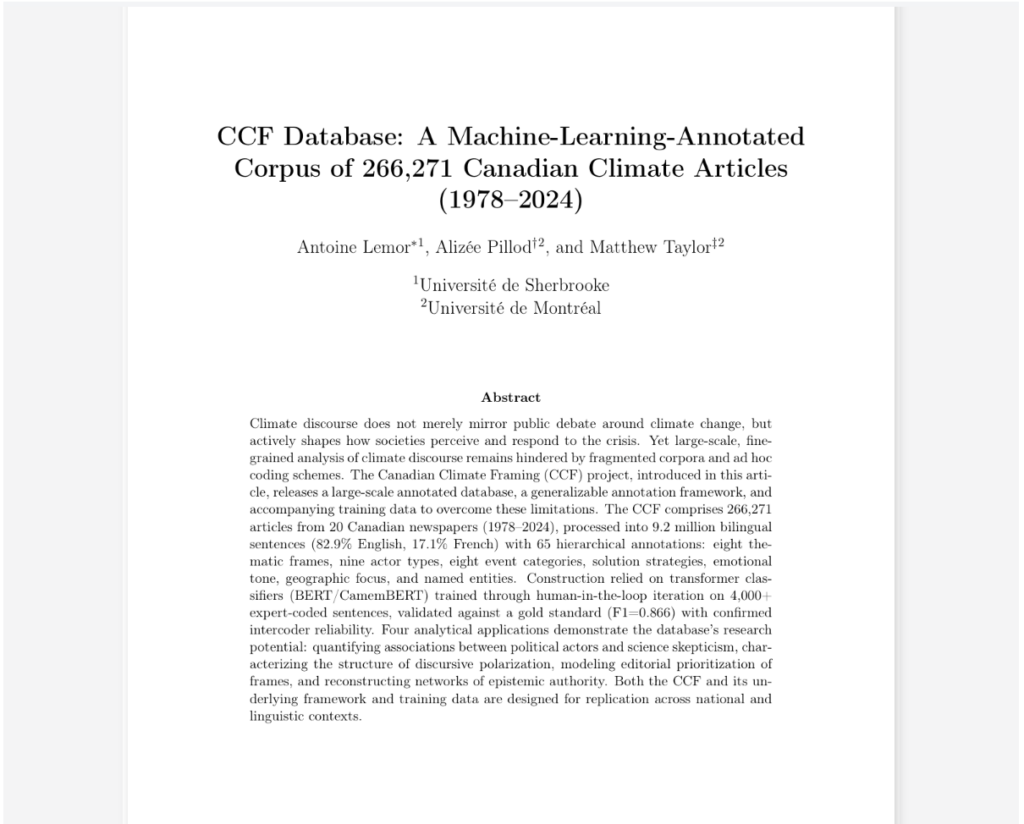
Introducing the Canadian Climate Framing (CCF) database
In collaboration with Antoine Lemor and Matthew Taylor, we are preparing the public release of the Canadian Climate Framing (CCF) database, a unique resource designed to help researchers analyze how media coverage of climate change has evolved across time, space, and language in Canada.
Unlike previous datasets, which are often limited in scope, timeframe, or geographic coverage, the CCF brings together articles from 20 national and regional news outlets across the country, including French-speaking ones, spanning several decades—from the late 1970s to the present. It was developed using advanced natural language processing methods and supported by a rigorous validation strategy.
The database enables scholars to examine how climate change is framed in the media—as a public health, national security, economic, justice, cultural, political, scientific or environmental issue—who is given a voice in climate debates, which focusing events shape coverage, and how emotions and psychological distance are conveyed in news reporting.
The CCF is currently under review for publication. We hope this new resource will significantly strengthen our understanding of climate communication in Canada and support future research in this field.
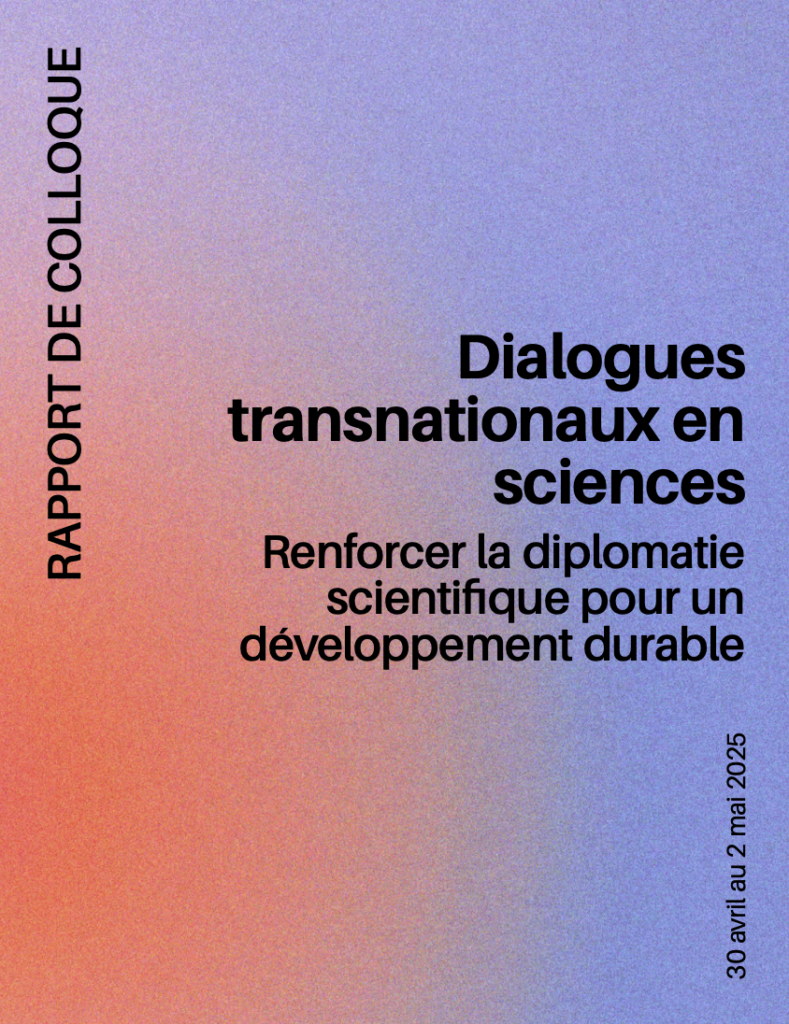
Toward durable science diplomacy
In collaboration with Universidade Estadual de Campinas, Universidade do Estado do Rio de Janeiro, and Quebec’s International Relations Ministry, this initiative examines how science diplomacy can be strengthened as a long-term strategic lever for addressing global challenges in a context of geopolitical fragmentation and accelerating techno-scientific change. Building on collaborations between Brazil and Quebec, it brings together experts, researchers, and policymakers to reflect on how science–policy interfaces can better address global issues such as climate change, health, artificial intelligence, education, open science, and scientific diasporas.
Reference
Bonacina, A., Pillod, A., Kagorora, F., et Loiola, F. (2025). Dialogues transnationaux en sciences : Renforcer la diplomatie scientifique pour un développement durable. [Rapport de colloque]. Montréal, Canada.

How to talk about climate change to encourage action
In collaboration with the Ouranos Consortium and presented to Quebec’s Environment Ministry, this project explores how to communicate on climate change effectively during times of concurrent crises, such as the COVID-19 pandemic. Our research focuses on strategies that avoid overwhelming the public while keeping the climate crisis top of mind, fostering both individual action and social acceptance of climate policies. We examine how to balance urgency with empathy to maintain public engagement in critical environmental issues.
Reference
Boivin, M., Champagne St-Arnaud, V., Briand, A.-S., Généreux, M., Lachapelle, E., Landaverde, E., Pillod, A. et Scheed, H. (2023). Communiquer sur l’adaptation aux changements climatiques dans un contexte pandémique au Québec. Rapport final présenté à Ouranos et au ministère de l’Environnement, de la Lutte contre les changements climatiques, de la Faune et des Parcs (MELCCFP). Montréal, Canada.

Media coverage and electoral politics
While my research typically focuses on climate change coverage, I also collaborate with other researchers on other intriguing topics. In this article, my colleague Philippe Chassé and I explore how politicians who stray from the linguistic norm — particularly those with regional accents — are portrayed in the media. Focusing on a case from southern France, we show how accents become powerful political signals, sparking mockery, fascination, or resistance. More than just a matter of phonetics, we argue that language remains a central fault line in how legitimacy and authority are constructed in public life.
Reference
Chassé, P., and Pillod, A. (2023). J’ai un accent, moi ? Les médias et les caractéristiques « atypiques » des personnalités politiques. Glottopol, n°39, 185-212.

Climate change as a health issue in the media
My Master’s thesis examines how The Globe and Mail frames climate change as a public health issue between 2008 and 2020. I find that the health frame is not only underused but also often poorly deployed — frequently lacking credible messengers with medical expertise and failing to convey the full scope of health impacts. The analysis highlights a missed opportunity to connect climate change with public concern and engagement.
Reference
Pillod, A. (2021). Reframing Climate Change as a Public Health Issue: a Canadian Case Study, 2008-2020 [Master’s thesis, Université de Montréal]. Papyrus.